December 30, 2015

Fallout 3 Review


Fallout 3 is a First/Third Player RPG Shooter game in an open wasteland scenario. Your goal is to survive the post-apocalyptic world in order to find your father, that left you for no apparent reason. This game marks the comeback of an old favorite franchise, made by the hands of Bethesda, well known for the Elder of Scrolls games.


Let's start with the best in Fallout 3: Perks and VATS.
Perks are unique options you can choose every time you level up. Some of them open unique mechanics for the game, like the Cannibal Perk, which allows you to feed on dead corpses to restore health or the Bloody Mess Perk, which gives a chance that every kill will end up in a violent death animation.
VATS System
VATS stands for Vault-Tec Assisted Targeting System. Despite the fancy name it is fairly simple, every creature is made by different members (like legs, arms, torso and head) and all of them have their own health. Depending on your position relative to your target your chance to hit those areas changes. Do enough damage and you cripple the member, unless you do enough damage to kill the creature all together. This system works all the time and you are also subjected to it. On top of it you have a limited amount of actions point that you can use every few seconds to slow time and pick by hand the member you want to shoot at.

The Skills system is very simple, but yet important to how the game operate, as every action success chance is determined by them. We like to divide the skills in two big categories: Combat and Survival. Combat skills affect your direct damage with weapons, like big guns, small guns, melee, etc. Survival skills are abilities that will help you survive the wasteland, like sneaking, medicine, speech, etc. One that we think plays special role in the game is the Repair Skill, because it synergizes well with the equipment duration mechanic. Just like in real life, the more you use an equipment, the faster it will break. But if you have a second piece of that same equipment you can salvage parts and repair the first one. This one skill is the sole responsible for most of the in-game money we made, damage we caused, weight we condensed and blood we kept in our veins.
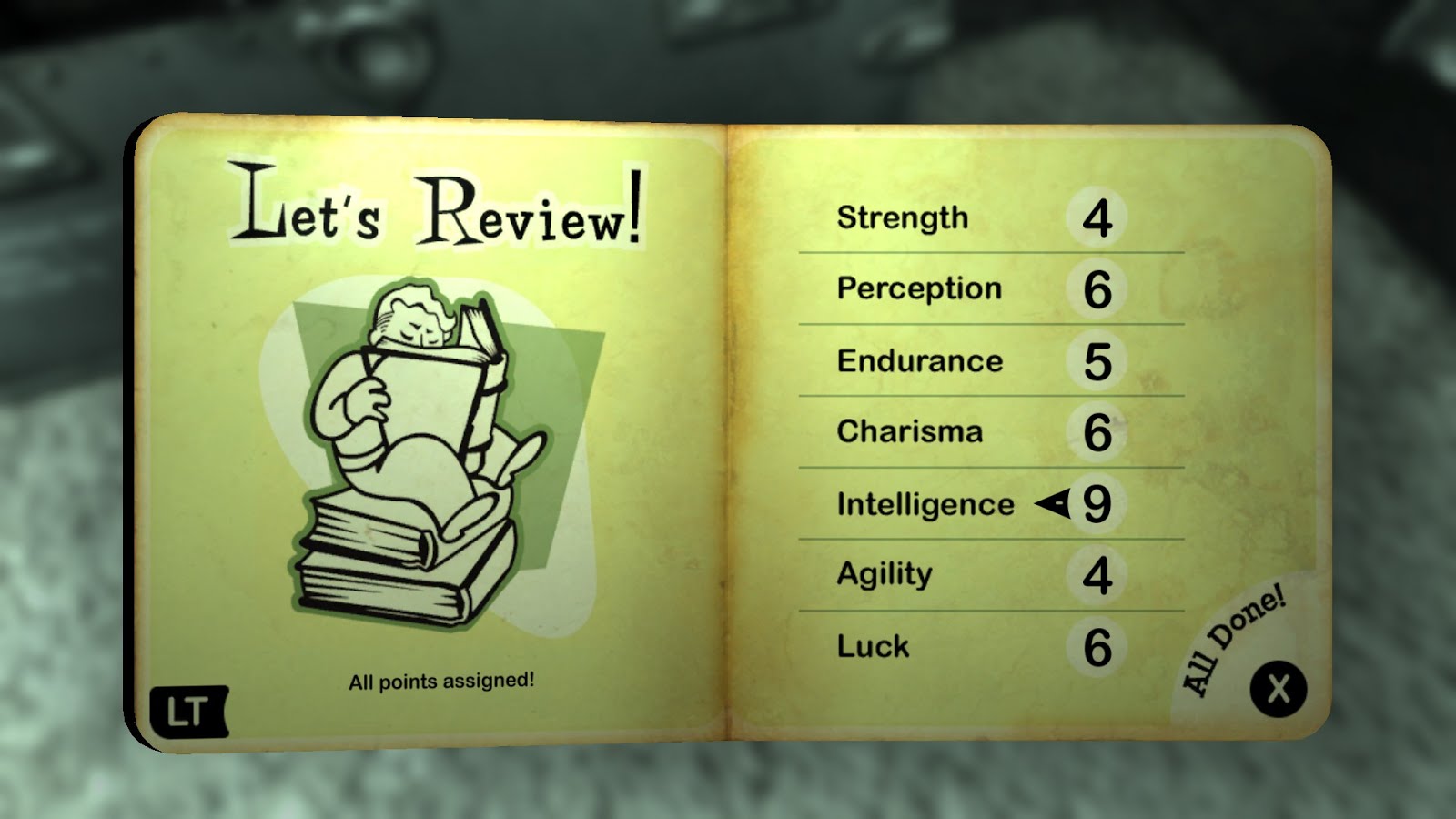
To wrap up we have to talk about the game core mechanics: Attributes, Karma and Radiation.
Attributes are defined as a simple status page (called S.P.E.C.I.A.L.), and each will raise some skills or other status, like health, max weight or action points (used in VATS). Karma has a special place in the game, as every action you take can be considered either Good or Evil, and the game will keep track of them. If your karma is not neutral you might have special dialog options or even exclusive bonuses with different factions inside the game. Nothing fancy, but adds to the role play.
Enough Radaway for 3k+ radiation
Now being in a post nuclear world wouldn't make sense without radiation, right? Radiation plays a big role in the game plot, but mechanically is very dull. Every food, water or region has radiation somehow, the more you enter in contact with it, the sicker you get. Get sick enough and on top of loosing a couple of SPECIAL points you will die. But for you, as the player, to heal radiation is no big deal, any medic in the world will give you a full treatment or you can just carry an endless supply of radiation pill. It just doesn't really make sense that the world is struggling so much with radiation when there are a seamlessly infinite amount of radiation "cure" just laying around. We would have liked it to be a more severe or restrict system, that instead of killing you, could just make you very weak, like everyone else in the wasteland.


Fallout 3 is a bridge between how games used to be in the 90's and how games started to be after the year 2000. The open world and moral choices that the game offers also add a lot of depth to the story. This game is definitely a must and will give you hours upon hours of gameplay!

Final Score: 10 out of 10.

November 30, 2015

Half-Life 1 Review


Half-Life 1 is a First Person Shooter game in which your goal is to escape a scientific disaster while fighting your way through hordes of enemies. Released in November 1998, Half-Life 1 raised the standards for the whole game industry. Many of the design principles that are used today, almost two decades later, were set with this game.


For today standards, the game is mechanically very simple, you have about dozen different weapons and you have to beat, shoot, explode or disintegrate your enemies. What makes this game very interesting, even today, is that the whole plot happens as you play. Throughout the game you will face different forms of puzzle that will require different problem solving techniques to successfully reach the end, using no more than jumping, crouching, and one "interact" button.


Despite the simplicity, Half-Life 1 shows that is not the amount of different mechanics that makes an excellent game, but how the mechanics themselves can be weaved together to bring interesting interactions to life.

Final Score: 7 out of 10.
(Were we in 1998, this would easily be a 10.)

November 20, 2015

Fallout Shelter Review


Fallout Shelter is a simulation game based on the post-nuclear world franchise with the same name, where your goal is to create a "perfect" thriving community, 2000 feet under the surface. It is a very simple game that can be played very casually.


Our vault after couple days...
The main challenge is having power, food and water, the resources to keep your vault running. Power is essential for rooms, the more rooms you have, more power you will need. Dwellers, the people in your vault, need food and water to stay alive. The lack of any resource will affect your vault. Shortage of power will shut down rooms, like the ones you produce food at. Scarcity of water or food will make dwellers loose health due to contaminated water and hunger. If in need, you can rush the production of a specific room in order to produce the resource immediately, but in case of failure you will have a disaster to handle.

Each dweller have a set of SPECIAL, attributes that will affect their performance and productivity in specific rooms. SPECIAL stands for Strength (power room), Perception (water room), Endurance (food and water rooms + health), Charisma (radio room), Intelligence (medical room), Agility (food room) and Luck (rushing). Each attribute also improves the odds of survival during wasteland exploring, when you send a dweller out of the vault to look for useful stuff, like weapons and outfits. Fortunately SPECIAL attributes can be trained in training rooms.
The game always provide three objectives that you can aim for. Every time you complete one, you will get a reward and a new objective. We have gathered some data regarding this system that we would like to share, hopefully it will help you decide if it is worth your time and effort.

Unfortunately some mechanics do not scale well later in the game. Sending too many explorers out will require you to spend most of your time clicking endlessly to sell normal items. Which could be solved by having a "sell all" button. Outside invaders gets diminished to the point where they are more of an annoyance than actual danger. And further expanding your vault will only require you to click more constantly to harvest resources, than giving any challenge with planning or management.


Mr. Handyman lines are the best! :)
Despite the limitations of the end-game content, it is the only mobile game to actually catch our attention in a long time. It is free to play and can provide you many hours of entertainment, specially if you give yourself crazy limitations like: All Male/Female Vault, No Weapons, No Training Rooms, No Food, etc. If you are a Fallout fan you should definitely try it out! 

Final Score: 8 out of 10.


Data Collected:
126 Objectives Completed,
20 Lunchboxes awarded from Objectives,
42 Lunchboxes Opened,
8 Legendary Drops,
14 Lunchboxes "last card" were x500 CAPS.
9 Lunchboxes gave two rare rewards,
5 of which were x500 CAPS.

Statistics:
15,9% Chance for an objective reward to be a Lunchbox.
19% Chance for a Lunchbox to award a legendary item.
33% Chance of your rare "last card" to be x500 CAPS.
21% Chance for two rare drops per Lunchbox.
55% Chance of an extra rare drop to be x500 CAPS.

(For those wondering, all legendaries came from the last card, which is always rare or legendary, never from an extra rare reward.)

PS: In case you wonder if those 40 Lunchboxes deal for 20 bucks is worth your money, we NEVER got a Mr. Handy from a Lunchbox, despite people on the internet saying they did.

Our vault "top" section after 110h of gameplay.

October 30, 2015

Broken Age Review

Broken Age is a point-and-click puzzle game. You will play simultaneously as Vella and Shay, two souls with very different backgrounds and aspirations, but whose stories are more linked than you can imagine. Your goal is to solve the puzzles in order to progress the story.


As a point-and-click game, there is only one interactive mechanic, you move the cursor (and your character) around the scene and interact with objects and NPC's. Most of them only give you snippets of story that you will have to put together in order to solve the puzzles. Some objects can be taken and used to interact with other objects and NPC's in the game. On top of that there is a nice highlight whenever your cursor is over an object that can be interacted with, so you don't have to click on every nail you see until you find something new.


This game has a very interesting story, with great art, animation, music and a LOT of voice over. Every object can be interacted with everything else, we got some good laughs out of crazy situations. The puzzles themselves are not hard, just remember to use your items.

Final Score: 7 out of 10.

September 30, 2015

The Banner Saga Review


The Banner Saga is a turn-based strategy game with a heavy focus on story telling. Your goal is to survive the travel with as many people in your caravan as possible. What is unique about this game is that every decision you make will have an impact on the plot somehow, forcing you to think twice before picking any option, as not only will you have to live with the consequences to the end, but you will have to adapt your strategies quickly in order to survive. 


The combat system may seem daunting at first, but it is quite simple. After a couple of fights you will feel like an expert on it, but don't let that discourage you, there is plenty of room to explore different strategies and combinations. The mechanic boils down to two attributes: strength and armor. Strength serves as both health and damage, so as your character gets hit, he does less damage. Armor protects your strength by adding an extra layer of defense, but it can be bypassed by doing less total damage. On top of that you have character turns, movement, positioning, passive and active skills. That is where the most of the strategy will come from, when you are building your party or fighting enemies that have different compositions. For example, archers have long range, do minimal armor damage and have extra damage to enemies whose armors have been destroyed, but they lack enough strength to do damage on heavy armored characters, depending on others do bring them down first.

The other main mechanic on this game is the caravan system. As you travel on foot days goes by pretty quickly, and the more people in your caravan the more resources they will consume. Here is where most of the choices you make during your game will affect you. If you refuse to help a group of people in need, your caravan may lose morale and be less effective in combat, but that might be the difference between starving yourself or having enough food for reaching the nearest town. This is just one example, the game will have many other surprises to you that we would not like to spoil!

The two systems are wrapped by a currency called renown. This currency is acquired by killing enemies in battle and doing "good" deeds. You require renown to buy supplies for your caravan, buy items and level up your characters. That means the more people in your caravan, more supplies will be consumed per day, more renown will be spent buying supplies and less will be left to strengthen your troops. This shared currency balances the game for you. If you are doing well in battle your caravan will grown, preventing you from leveling up your characters, which will make the following combats more difficult. If you perform not as well in combat, people will die and your caravan size will decrease, leaving you more renown to spend on your warriors and, therefore, making the following combats easier.


The Banner Saga is the first part of a trilogy, so the story doesn't end here, leaving a lot to be told. Despite that, the game has amazing art work, good music, a good approach to player failure (after all, you don't win every battle you fight), and a "not going back" approach that enhances the weight of every decision you make, leaving you with a unique feeling of consequence upon your choices.

Final Score: 9 out of 10.